How to Choose the Best Dedicated Creative Team
The criteria to judge a dedicated creative team on, from B2B competence and continuity to scaling without a hire, and the use cases it fits best.
A dedicated creative team is a standing group that works only on your brand and produces your creative across formats, week after week. It gives you the continuity of an in-house team with the capacity and range of an agency, on a predictable monthly cost. If you are still weighing whether a dedicated team is the right model at all, against freelancers, an agency, or an in-house hire, start with a dedicated team versus freelancers and agencies. This guide picks up once you have decided the model fits: the criteria to judge a team on, and the use cases it fits best, so you choose well.
What to look for in a dedicated creative team
These are the criteria that separate a team that works from one that disappoints.
B2B creative competence. Ask for B2B examples, not just attractive design. The team should understand longer sales cycles, multiple stakeholders, technical subjects, and the difference between awareness content and conversion assets. Look for work across the formats you need: brand systems, video, motion, web, decks, social, ads, and landing pages.
A named team and real continuity. The question that matters is who actually does the work. A dedicated team should give you named roles, a creative lead, designers, a writer, a motion or video specialist, and a project manager, and commit to keeping the same people on your brand rather than rotating staff. Ask for a documented onboarding period for your brand, your ICP, your product, and your approval process, and a single accountable point of contact who still lets you reach the people making the work.
A production system, not just talent. For ongoing work, process matters more than individual brilliance. Look for a repeatable path from brief to delivery: an intake form, a project-management tool, a review and revision policy, asset and source-file governance, and clear turnaround standards. That is what keeps quality steady as the volume grows.
Elasticity. The team should raise output for a launch or a campaign without asking you to recruit, and scale back in quiet periods without penalty. Ask directly: what is the notice period to add or remove capacity, and what happens if a key person is away.
Brand immersion. A dedicated team should work like an extension of your company, not a vendor waiting for instructions. That means brand-book fluency, a living library of your assets, and enough exposure to your product and campaigns to keep the work consistent across every channel.
Commercial clarity. Avoid vague arrangements. The agreement should spell out scope, expected volume, turnaround, how many revision rounds are included, who owns the finished work and the source files, and the notice period to change or end it. Clear terms are a sign the provider runs this as a real service, not a favor.
Which use cases a dedicated creative team fits best
A dedicated team is strongest in four situations, which are the ones buyers most often describe.
An ongoing content engine. When you need a steady flow of social creative, ad variants, email assets, blog visuals, and video cuts, a standing team produces to a schedule instead of starting each request cold.
Campaigns across formats. When a campaign needs a landing page, a set of ads, a video, and a deck, all aligned, a team runs them in parallel while holding one look, rather than passing pieces between separate freelancers.
Product launches and other peaks. When a launch spikes the workload for a few weeks, a dedicated team scales up for the peak and back down afterward, without a hire you have to unwind later.
Scaling without hiring. When creative demand is growing faster than your headcount plan, a dedicated team adds capacity and range without the cost and delay of recruiting each specialist.
How Room4 Teams measures up
Room4 Teams is built as a dedicated creative team, and it meets the criteria above by design. You get the same named people working only on your brand, led by a creative director, so the work stays consistent instead of restarting with each request. The team is drawn from the talent your work needs: graphic designers, motion graphics artists, video editors, UI designers, web designers, and web developers, so one arrangement covers the formats a full program spans.
You brief the work and approve it. A project manager and the creative director own the intake, the resourcing, the revisions, and the quality control, so the production runs as a managed system rather than a set of tasks you coordinate. The team onboards to your brand and works from master templates that hold the library together, and you receive the source files, so the work and the assets are yours. The fee also covers the software and AI tools the team needs, stock videos and photos, unlimited tasks and revisions, and a secure portal.
On elasticity, you can grow the team immediately for a launch and reduce it with one month's notice, so capacity tracks your demand. You have a full team producing within two business days of starting, and a dedicated team runs around 45% less than the loaded cost of hiring the same role in-house (salary plus employer taxes). See what we produce and how it works, or read a dedicated team versus freelancers and agencies and a dedicated team versus hiring in-house.
Frequently asked questions
What is a dedicated creative team?
How do you judge a dedicated creative team before committing?
What should you look for when choosing a dedicated creative team?
Which use cases is a dedicated creative team best for?
How does Room4 Teams work as a dedicated creative team?
More on Dedicated Teams
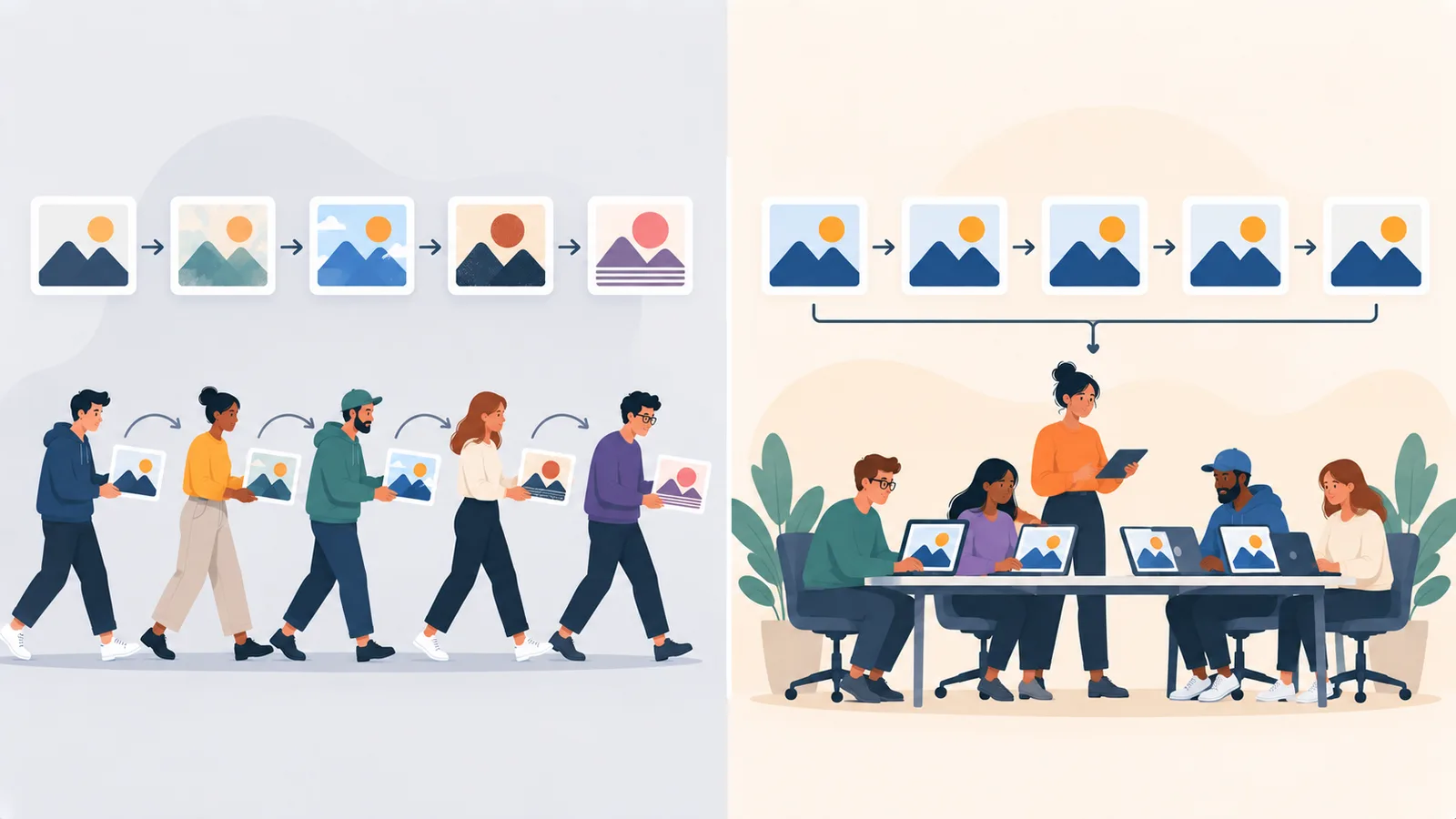
Same Designer Every Time: Why a Rotating Queue Costs You
Most design subscriptions assign a different designer to every request, so each restarts at day one. What that costs you, and why a dedicated team is better.

A Dedicated Team to Produce Your B2B Industry Content
Get a dedicated creative team that produces your content for complex sectors: fintech, cybersecurity, health tech, clean tech. Built to produce, not just advise.

How a Cybersecurity Firm Cleared Its Content Backlog
A B2B cybersecurity company had a content backlog and unreliable freelancers. Here is how a dedicated creative team cleared it, on time and accountable.