How a Cybersecurity Firm Cleared Its Content Backlog
A B2B cybersecurity company had a content backlog and unreliable freelancers. Here is how a dedicated creative team cleared it, on time and accountable.
A B2B cybersecurity company came to us with a growing content backlog. They had been working with freelancers and several outsourcers, and the setup kept breaking down: the people making their content did not understand the business well enough, and availability was unpredictable, with work stalling when someone went on holiday or stopped replying.
They switched to a dedicated creative team supervised by a project manager and a creative director. The backlog cleared, delivery became reliable, and their internal team got its time back in two ways: they no longer onboard and train a new person for every project, and they no longer chase and coordinate scattered providers. The team's project manager and creative director handle the onboarding and supervision, so the marketing and product teams now do one thing, brief the work, and receive finished output, on time, reviewed, and ready to approve. This is how the change played out.
The challenge: a backlog that kept growing
The company had more content to produce than their scattered setup could handle. Work was spread across freelancers and several outside providers, and the requests piled up faster than the group could clear them. A backlog is not just a queue; in a fast-moving, technical space like cybersecurity it means campaigns wait, launches slip, and the marketing team spends its week chasing assets instead of running the plan.
Why the freelancer and outsourcer setup broke down
Two problems ran underneath the backlog, and both are common when creative work is split across freelancers and multiple vendors.
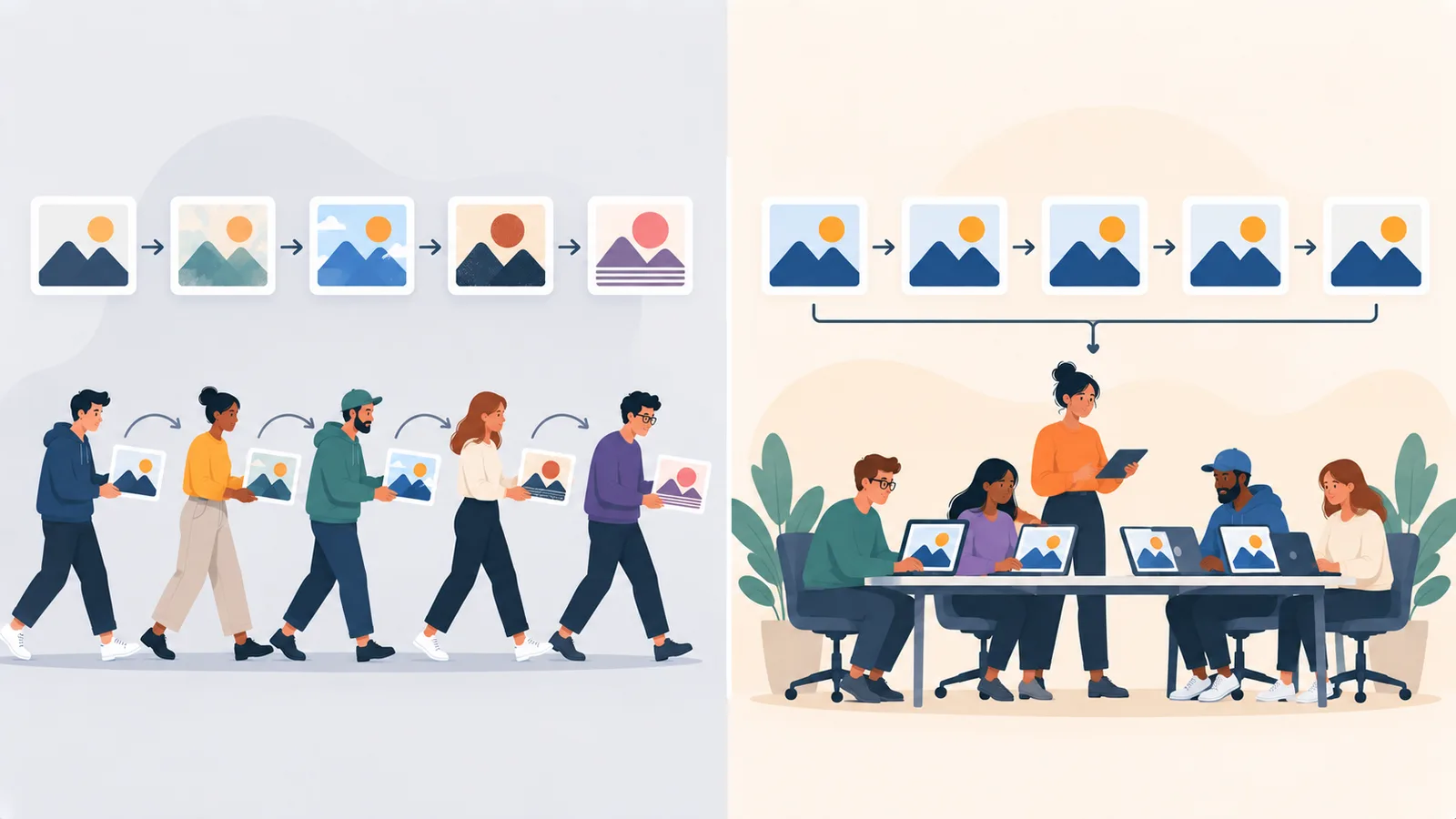
First, the people producing the content did not understand the business. Cybersecurity is technical and specific, and every brief had to re-explain the product, the audience, and the positioning. That context did not carry from one freelancer to the next, so quality varied and revisions multiplied. Second, availability was unpredictable. Freelancers went on holiday or went quiet, and when they did, the work simply stopped. There was no one accountable for delivery across the whole set of requests, so a single unresponsive person could hold up a campaign.
There was also a hidden time cost that is easy to miss. Every new freelancer had to be onboarded, trained on the product, and guided through the first few rounds before their work was usable. With people rotating in and out, the client's own team was paying that onboarding and hand-holding cost over and over, on top of the actual creative work.
The result was a lot of wasted effort inside the client's own team: onboarding and training each new person, briefing the same context again and again, coordinating several providers, and covering the gaps when someone dropped off.
The solution: a dedicated team that is accountable
The company moved to a dedicated creative team that works only on their brand, supervised by a project manager and a creative director who own the quality and the delivery.
That structure fixed both problems at once. Because the same people work on the account, they learned the business, the product, and the positioning, so briefs stopped starting from zero and the work came back on brand. And because a project manager and a creative director supervise the team, there is a clear line of accountability: someone owns the schedule, the review, and the finished output, rather than delivery depending on whether one freelancer happens to be available.
It also moved the onboarding burden off the client. The project manager and creative director handle the onboarding, supervision, and day-to-day guidance of the creatives, so when the team grows or a person changes, the client does not have to train anyone. The client is not chasing individuals or bringing new people up to speed; they are working with a team that is answerable for the result and manages its own people.
The outcome: finished work, on time, with less waste
The backlog cleared, and delivery became predictable. The most valuable change for the client was what it did to their own team's time. Instead of onboarding a new person for every project, briefing the same context repeatedly, coordinating several providers, and covering gaps, they now hand over the work and get the final product back done on time, reviewed internally by the creative director, and ready for their approval.
That collapsed their role down to the three things that actually need them: making the requests, writing the brief, and receiving the output. The onboarding, training, supervision, and guidance now sit with the team's project manager and creative director, not with the client. Removing that repeated work took a lot of unnecessary resource wastage out of the marketing and product teams, who got their week back to focus on strategy rather than production logistics.
If this sounds like your situation
The pattern is familiar: content demand outgrows a setup built on freelancers and scattered vendors, context keeps getting lost, and delivery depends on whoever is available. If that is where you are, a dedicated creative team is the structural fix, because the same people learn your brand, and a project manager and creative director own the delivery, the onboarding, and the supervision, so your team only briefs and approves instead of training and chasing.
Room4 Teams gives you that team, drawn from the talent you need: motion graphics artists, video editors, graphic designers, UI designers, web designers, and web developers. The fee is all-inclusive: it covers a project manager and a creative director, so you do not pay extra for their hours, plus quality control, all the software and AI tools the team needs to produce content efficiently, stock video and stock photos, unlimited tasks and revisions, and a secure portal. You get production priority because the team is dedicated to you, you receive the source files, and the team works over Slack or inside your existing tools. On cost, a dedicated team runs around 45% less than the loaded cost of hiring the same role in-house (salary plus employer taxes). See what we produce and how it works, or read more on the design bottleneck and freelancers vs an agency vs a dedicated team.
Frequently asked questions
What problem did the cybersecurity company have?
Why did the freelancer and outsourcer setup fail?
How did a dedicated team fix it?
What changed for the client's internal team?
How does a dedicated team save time, not just cost?
More on Dedicated Teams

How to Choose the Best Dedicated Creative Team
The criteria to judge a dedicated creative team on, from B2B competence and continuity to scaling without a hire, and the use cases it fits best.
Same Designer Every Time: Why a Rotating Queue Costs You
Most design subscriptions assign a different designer to every request, so each restarts at day one. What that costs you, and why a dedicated team is better.

A Dedicated Team to Produce Your B2B Industry Content
Get a dedicated creative team that produces your content for complex sectors: fintech, cybersecurity, health tech, clean tech. Built to produce, not just advise.