White Label Creative: How It Works for Agencies
White label creative lets your agency deliver design, video, and motion under your own brand. Here is how it works and what to check before you sign.
White label creative is creative production, design, video, motion, and web, made by an outside team and delivered under your agency's brand. You win the work and keep the client; the team produces behind a confidentiality agreement; you present the finished files as your own. Your client never learns another team was involved.
It covers the full range of creative formats, runs on an NDA, and ships clean source files with no trace of the team behind them. This guide explains what white label creative covers, how the process works, the three risks to check, and how to choose a partner.
What is white label creative?
White label creative means a production team makes the creative work and your agency puts its name on it. You keep the client relationship, the strategy, and the margin. The team supplies the production capacity you do not have in-house, or do not want to hire for.
The reason agencies use it is simple: you win more work than your team can produce, and a white label creative partner gives you the output without adding headcount. You take on the campaign, the retainer, or the overflow, and deliver it as your own.
What does white label creative cover?
The strong partners cover the full range, not one format. That matters, because a single client brief often needs several formats at once, and juggling a separate vendor for each means more contracts, more NDAs, and more handoffs.
Full-scope white label creative covers graphic design, motion graphics, video production, social ads, and web design and development. When one team handles all of it, you can say yes to a wider brief without building the capacity yourself. You brief once, and the work comes back on brand across every format.
How does white label creative production work, step by step?
The process is straightforward once the agreement is in place.
First, you sign a confidentiality agreement that binds the team to work only with you and keep the relationship private. Second, you send the brief: the client goals, the brand guidelines, the formats, and the timeline. Third, the team produces the work under your brand, following your guidelines, not theirs. Fourth, you review, request changes, and approve. Fifth, you deliver the finished work to your client as your own.
A standing team runs this on repeat. You are not re-hiring for each project; the same team learns your brand and your clients' brands, so briefs move faster over time and less gets lost between rounds.
Will my client know I used a white label team?
No, and this is the first risk to check. A white label creative partner is NDA-backed and works only with you. It never contacts, approaches, or names your client. Your client deals with you, and only you.
That rule protects you both ways, and it is proof you can point to. A team that keeps your relationship private keeps every agency's relationship private. It does not name the agencies it produces for, and it does not put their work in its own portfolio. Ask a prospective partner whether they name any client. The right answer is no.
Will the work ship clean under my brand?
Yes, and this is the second risk to check: brand neutrality. Deliverables and source files should arrive with no trace of the production team, nothing in the artwork, the file names, the exports, or the document properties. You present the work to your client without stripping anything out first.
Ask for the source files, not just flattened exports. You want the working files so your team can make a later change without going back to the partner for every edit. The work is yours to hand over and yours to keep.
Will quality hold as the volume grows?
This is the third risk: quality drift, where the first few jobs land well and the work slips once volume climbs. The answer is who produces the work and how steady the team stays.
Room4 Teams runs 60 in-house creatives, mid and senior people who read a brief and get it right. 93% of them stay through to the end of their contract, so the team that learns your brand is still producing months later. If you ever need a change, a replacement starts within three business days. Consistency comes from a team that knows your brand, not a queue that hands each job to whoever is free.
How is white label creative different from a freelancer or a subscription?
All three give you extra hands. What differs is who owns the brand knowledge and who carries the risk.
| Freelancer | Subscription queue | White label creative team | |
|---|---|---|---|
| Who does the work | One person, one skill | Whoever is free that day | A dedicated team that learns your brand |
| Format range | Usually one | Often design only | Full scope: design, motion, video, web |
| Brand consistency | Depends on the person | Drifts across handoffs | Held by a standing team |
| Confidentiality | Varies, often none | Rarely NDA-backed | NDA-backed, never contacts your client |
| If someone leaves | You start the search | Back in the queue | Replacement within three business days |
A freelancer fits a single task in one skill. A subscription queue fits small, sporadic needs. White label creative fits agencies producing ongoing volume across formats that has to ship clean under their brand.
How Room4 Teams provides white label creative
Room4 Teams produces creative work under your brand as a standing team, not a one-off booking. You brief the work through a dedicated creative project manager who runs communication and quality control; creative direction interprets the brief; the team produces, checks, and delivers on brand and on time. All communication runs through you, and we never contact your end client. For the mechanics start to finish, read how white labeling works, and for the evaluation checklist, how to choose a white label agency.
You choose how it runs. The managed service takes the briefs and returns finished work, from one team member up, on one fixed monthly fee that covers unlimited tasks, unlimited revisions, and the full tech stack: all software, all AI tools, and all the stock libraries we use. The integrated option embeds our creative production in your tools. You set priorities and approve the output; we remain responsible for our people, methods, and quality.
On cost, a dedicated team runs around 45% less than the loaded cost of hiring the same role in-house (salary plus employer taxes). See pricing. The team starts within two business days and flexes with one month's notice.
What to do next
Frequently asked questions
What is white label creative in simple terms?
What does a white label creative team produce?
Is white label creative the same as outsourcing?
Do I get the source files?
How fast can a white label creative team start?
More on White label
How to Choose a White Label Agency: Checklist
The right white label agency keeps your client hidden, ships clean under your brand, and holds quality at volume. Here is the checklist to pick one.
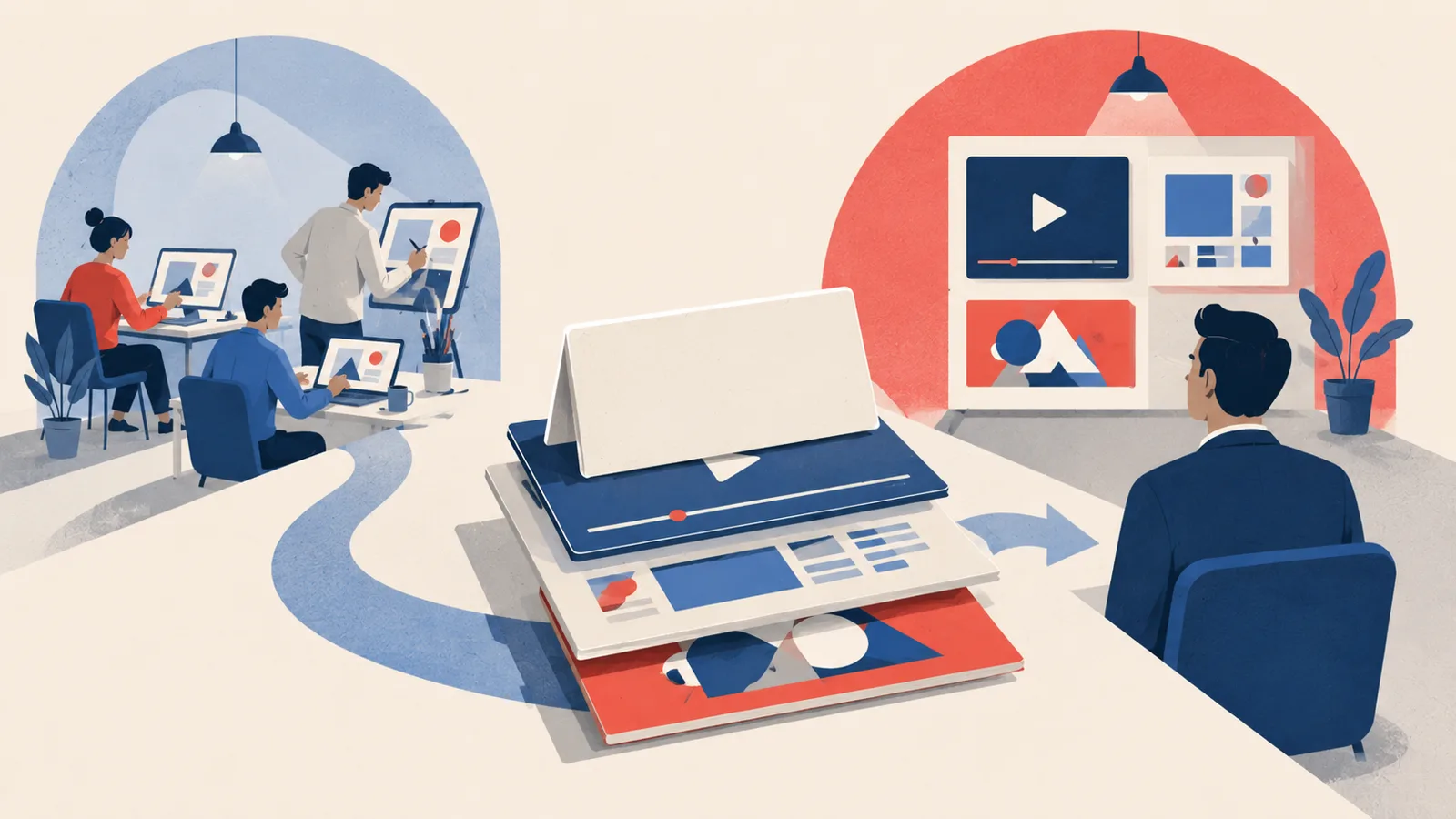
How Does White Labeling Work in Creative Production?
White labeling lets you resell creative work under your own brand. Here is how it works, from the NDA to clean source files you present as yours.