Marketing Collateral: What It Is, Types, and Examples
Marketing collateral is the branded content that attracts and nurtures buyers. Here are the types, how they map to the funnel, and what makes them work.
Marketing collateral is the collection of branded materials, print, digital, and multimedia, that a company uses to communicate its value, build awareness, and support sales across the buyer journey. It ranges from brochures and business cards to social graphics, infographics, explainer videos, one-pagers, and pitch decks.
The best collateral is mapped to the funnel, built for a specific audience and job, and kept tightly on-brand. This guide covers what marketing collateral is, the main types with examples, how it maps to the funnel, how it differs from sales collateral, and what makes it effective.
What is marketing collateral?
Marketing collateral is any customer-facing asset created to explain, prove, and sell what you do. It communicates your value proposition, builds awareness, and supports the sales effort at every stage of the buyer journey. The term once referred to printed sales-support materials, but today it covers the full range of offline and digital assets a company uses to attract, educate, and convert buyers.
The point of collateral is to do the explaining and persuading at scale, so your brand shows up consistently whether a buyer meets you through an ad, a guide, a booth, or a proposal. That is why it spans so many formats: each touchpoint in the journey needs its own asset.
What are the types of marketing collateral?
It helps to organize collateral by format. Most B2B and professional-services teams use a mix across three groups.
Print and physical collateral covers brochures and product catalogs, flyers and leaflets, business cards, event signage such as banners and exhibition stands, and branded merchandise. Digital documents and web assets cover website and landing pages, one-pagers and digital brochures, e-books and whitepapers, email and newsletter designs, and proposals and pitch decks. Visual and multimedia covers social media graphics and ad creatives, infographics, explainer videos and product demos, webinars and recorded presentations, and testimonial and case-study videos.
A handful of pieces sit closer to the sales process: case studies, product and spec sheets, pricing sheets and ROI calculators, and competitive comparisons. Those overlap with sales collateral, which the section below explains.
How does marketing collateral map to the funnel?
Effective collateral answers what the buyer needs at each stage of the funnel, so a full library covers every stage rather than crowding one.
| Funnel stage | Typical collateral | Primary job |
|---|---|---|
| Awareness (top) | Blog posts, social graphics, infographics, short videos, ads, landing pages | Attract attention, introduce the problem, capture leads |
| Consideration (mid) | E-books, whitepapers, webinars, product demos, email sequences, case studies | Educate, build trust, show your approach |
| Decision (bottom) | Tailored case studies, proposals, pricing sheets, ROI calculators, one-pagers, decks | Reduce risk, justify the investment, help close |
| Retention and advocacy | Onboarding guides, success playbooks, customer newsletters, referral assets | Reinforce value, drive renewals and referrals |
Mapping assets to stages this way stops gaps, where a stage has nothing to hand a buyer, and stops waste, where you have ten pieces for one stage and none for the next.
Marketing collateral vs sales collateral
The two overlap, and the distinction is about audience, timing, and purpose. Marketing collateral is the umbrella term for any branded material that supports the brand or a campaign, aimed at broad audiences to generate demand and move people from unaware to interested to engaged: blog posts, social assets, event graphics, general brochures, lead magnets, and website pages. Sales collateral is a subset used inside the sales process, usually one to one with a specific prospect in an active deal, to address objections, quantify value, and accelerate the decision: account-specific proposals, tailored case studies, ROI models, and competitive battlecards.
In short, marketing collateral attracts and nurtures; sales collateral helps close. For the deal-stage assets, see our guide to sales collateral.
What makes marketing collateral effective?
A few practices separate collateral that works from collateral that sits unused.
Start with the audience and the job to be done. Anchor each asset to a specific persona and the question they are asking at that funnel stage, and give each piece one primary goal, such as book a demo or download the guide. Enforce brand consistency. Use the same logo, colors, typography, imagery, and tone across every asset, and keep a simple brand guide so anyone producing the work stays on-brand without constant oversight. Lead with outcomes, not features. Translate what your product does into what the buyer gains, and use concrete, relevant proof. And design for scannability. B2B buyers skim, so use a clear visual hierarchy, keep the text tight, and let visuals, diagrams, and tables carry the complex information.
That fourth point is where design earns its keep, and the second is where it scales: master templates and a living brand system keep a large library consistent and let you refresh it without rebuilding each piece.
Why marketing collateral is a production challenge
Marketing collateral is a large, moving body of work. A full library spans dozens of formats across every funnel stage, all of it designed, all of it on-brand, and all of it needing refreshes as your product, positioning, and campaigns change. A single designer or an occasional freelancer cannot produce and maintain that range while keeping every asset consistent, so collateral goes stale, teams rebuild off-brand versions, and the library drifts.
That is a production problem. Keeping a marketing collateral library complete, on-brand, and current is ongoing design and video work at volume, which is exactly what a dedicated creative team is built to carry.
How Room4 Teams produces your marketing collateral
Room4 Teams gives you a dedicated creative team that designs and maintains your marketing collateral: brochures, social graphics, infographics, one-pagers, decks, ad creatives, landing pages, and explainer and case-study videos, on brand and kept current. You own the strategy, the messaging, and the brand; the team turns it into finished, consistent assets across every format and refreshes them as things change, from master templates that hold the whole library together. See what we produce.
You choose how it runs. The managed service takes the briefs and returns finished work, from one team member up, on one fixed monthly fee that covers unlimited tasks, unlimited revisions, and the full tech stack: all software, all AI tools, and all the stock libraries we use. The integrated option embeds our creative production in your tools. You set priorities and approve the output; we remain responsible for our people, methods, and quality. On cost, a dedicated team runs around 45% less than the loaded cost of hiring the same role in-house (salary plus employer taxes). See pricing. The team starts within two business days and flexes with one month's notice. Read more on sales collateral, brand consistency at scale, and the wider content creation services behind it. Agencies can have the team work under their own brand.
Request rates to see what your collateral library would cost.
Frequently asked questions
What is marketing collateral?
What are the main types of marketing collateral?
What is the difference between marketing collateral and sales collateral?
How does marketing collateral map to the funnel?
What makes marketing collateral effective?
More on Creative Production

When Your Marketing Team Is Designing in Canva: What to Hand Off
DIY design in Canva and AI tools is right for some work and costly for the rest. What it really costs, what to keep in-house, and what to hand off.
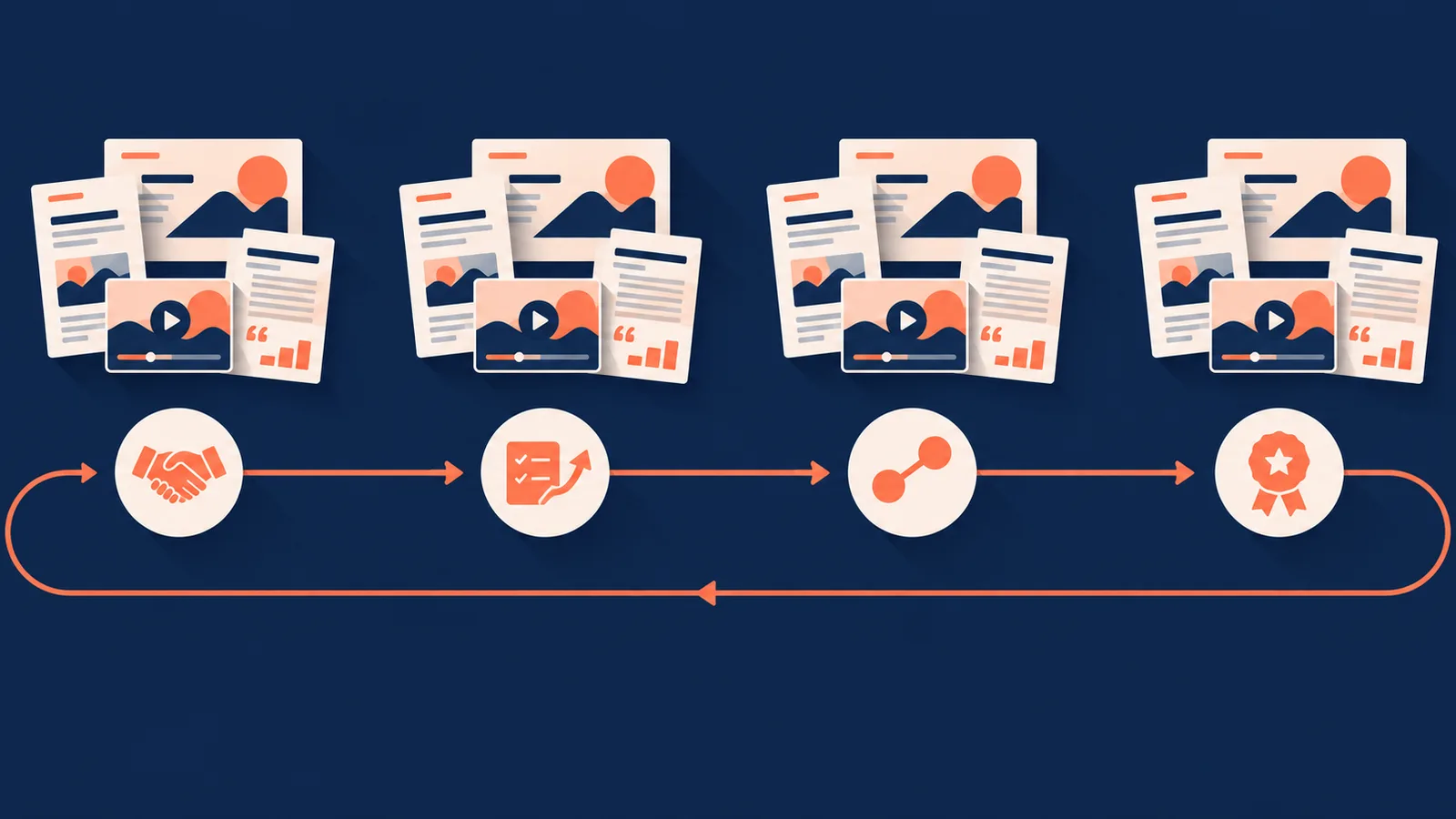
Marketing Collateral Design Services: The Whole Customer Journey
A dedicated team designs your collateral across the whole customer journey: sales, onboarding, referral, and advocacy. What it covers and how to choose one.

Covering a Designer’s Leave or Hiring Gap Without a 12-Month Contract
A maternity cover, a departure, or a launch needs capacity for a set period, not a permanent hire or a year-long contract. The options, and a faster way.