Sales Collateral: Types, Examples, and Best Practices
Sales collateral is the content sales teams use to close deals. Here are the main types, how they map to the buyer journey, and what makes them work.
Sales collateral is the set of documents and visual assets your sales team uses inside live deals to educate buyers, answer objections, and move deals forward. It is buyer-facing content shared in conversations and follow-ups: one-pagers, sales decks, case studies, ROI calculators, pricing sheets, spec sheets, and demo videos.
The best collateral is mapped to the buyer journey, built around the questions buyers ask at each stage, and kept tightly on-brand. This guide covers what sales collateral is, the main types with examples, how it maps to the buyer journey, and what makes it effective.
What is sales collateral?
Sales collateral is the collection of documents, visual assets, and media that sales teams use to educate buyers, answer objections, and advance deals through the B2B buyer journey. It is a core part of sales enablement: the right asset at the right moment proves value, reduces the buyer's perceived risk, and helps a buying committee reach agreement.
It is worth separating from general marketing content. A blog post is built to attract a wide audience. Sales collateral is buyer-facing content used inside an active deal, shared by a rep to answer a concrete question or overcome a specific objection. Marketing content brings people in; sales collateral helps them say yes.
What are the main types of sales collateral?
Most B2B teams use a core set of collateral types, and each answers a different need in the deal.
| Type | What it is |
|---|---|
| One-pager or sell sheet | A single-page overview of a product or use case: value proposition, key capabilities, and differentiators |
| Sales deck or pitch deck | A structured presentation for discovery, demo, or executive briefings: problem, solution, proof, next steps |
| Case study | A customer story showing how a similar company solved a problem and reached a measurable outcome |
| ROI or business case | A calculator or template that quantifies the financial impact: savings, uplift, payback period |
| Competitive battle card | A rep-facing comparison against key competitors: strengths, gaps, and answers to objections |
| Proposal or SOW | A formal document setting out scope, deliverables, timeline, and terms for the prospect |
| Pricing sheet | A clear summary of pricing tiers, add-ons, and what is included at each level |
| Spec sheet or datasheet | Technical detail: features, integrations, security and compliance, and requirements |
| Demo video | A short, scenario-based video showing how the product works for a specific use case |
The mix you need depends on your deals, but the pattern holds: buyers move through stages, and each stage calls for its own assets.
How does sales collateral map to the buyer journey?
B2B buyers move through awareness, consideration, and decision, and effective collateral answers the question the buyer is asking at each stage.
Awareness. The buyer is asking whether they have a real problem worth solving. The goal is to frame the problem and build credibility, so the collateral is educational: industry reports, explainer decks and infographics about the problem space, and one-pagers that define the category.
Consideration. The buyer is asking which solution is right for them and how it works. The goal is to show your solution solves the problem better than the alternatives, so the collateral gets specific: case studies matched to the buyer's industry and size, demo decks and recorded product demos, and feature comparison sheets.
Decision. The buyer is asking whether they can justify this to their CFO or committee. The goal is to remove risk and arm an internal champion, so the collateral is commercial: ROI calculators, formal proposals, pricing sheets, security and compliance documentation, and reference customers.
Mapping assets to stages this way prevents gaps and stops reps from sending the wrong asset at the wrong moment.
What makes sales collateral effective?
A few practices separate collateral that gets used from collateral that sits unused.
Start from the buyer's questions, not your product features, and build each asset around the specific objection or decision it needs to influence. Keep it concise and scannable, because B2B buyers skim: clear headlines, strong visuals, and the key point obvious in seconds, with outcomes and proof up front. Use real proof, not generic claims, with specific and quantified results and named customers where you are allowed to use them.
And enforce brand and messaging consistency, so every asset carries the same positioning, tone, and visual identity. That last point is where design does the heavy lifting: master templates for decks, one-pagers, and case studies keep the whole library consistent and let you update it without rebuilding from scratch.
Why sales collateral is a production challenge
Sales collateral is where design volume quietly explodes. Every persona, every stage, and every use case wants its own asset, so a full library is dozens of pieces, and each one has to be designed, kept on-brand, and refreshed as your product, pricing, and positioning change.
A single designer or an occasional freelancer cannot build and maintain that volume while keeping every asset consistent. The result: collateral goes stale, reps rebuild their own off-brand versions, and the library drifts. That is a production problem. Keeping a sales collateral library complete, on-brand, and current is ongoing design work at volume, which is exactly what a dedicated creative team is built to carry.
How Room4 Teams produces your sales collateral
Room4 Teams gives you a dedicated creative team that designs and maintains your sales collateral: one-pagers, decks, case studies, pricing and spec sheets, and demo videos, on brand and kept current. You own the messaging, the positioning, and the proof; the team turns it into finished, consistent assets and refreshes them as things change, from master templates that keep the whole library aligned. See what we produce.
You choose how it runs. The managed service takes the briefs and returns finished work, from one team member up, on one fixed monthly fee that covers unlimited tasks, unlimited revisions, and the full tech stack: all software, all AI tools, and all the stock libraries we use. The integrated option embeds our creative production in your tools. You set priorities and approve the output; we remain responsible for our people, methods, and quality.
On cost, a dedicated team runs around 45% less than the loaded cost of hiring the same role in-house (salary plus employer taxes). See pricing. The team starts within two business days and flexes with one month's notice. Read more on presentation design, brand consistency at scale, and the wider content creation services that support your team. Agencies can have the team work under their own brand.
Request rates to see what your collateral library would cost.
Frequently asked questions
What is sales collateral?
What are the main types of sales collateral?
How is sales collateral different from marketing content?
How does sales collateral map to the buyer journey?
What makes sales collateral effective?
More on Creative Production

When Your Marketing Team Is Designing in Canva: What to Hand Off
DIY design in Canva and AI tools is right for some work and costly for the rest. What it really costs, what to keep in-house, and what to hand off.
Marketing Collateral Design Services: The Whole Customer Journey
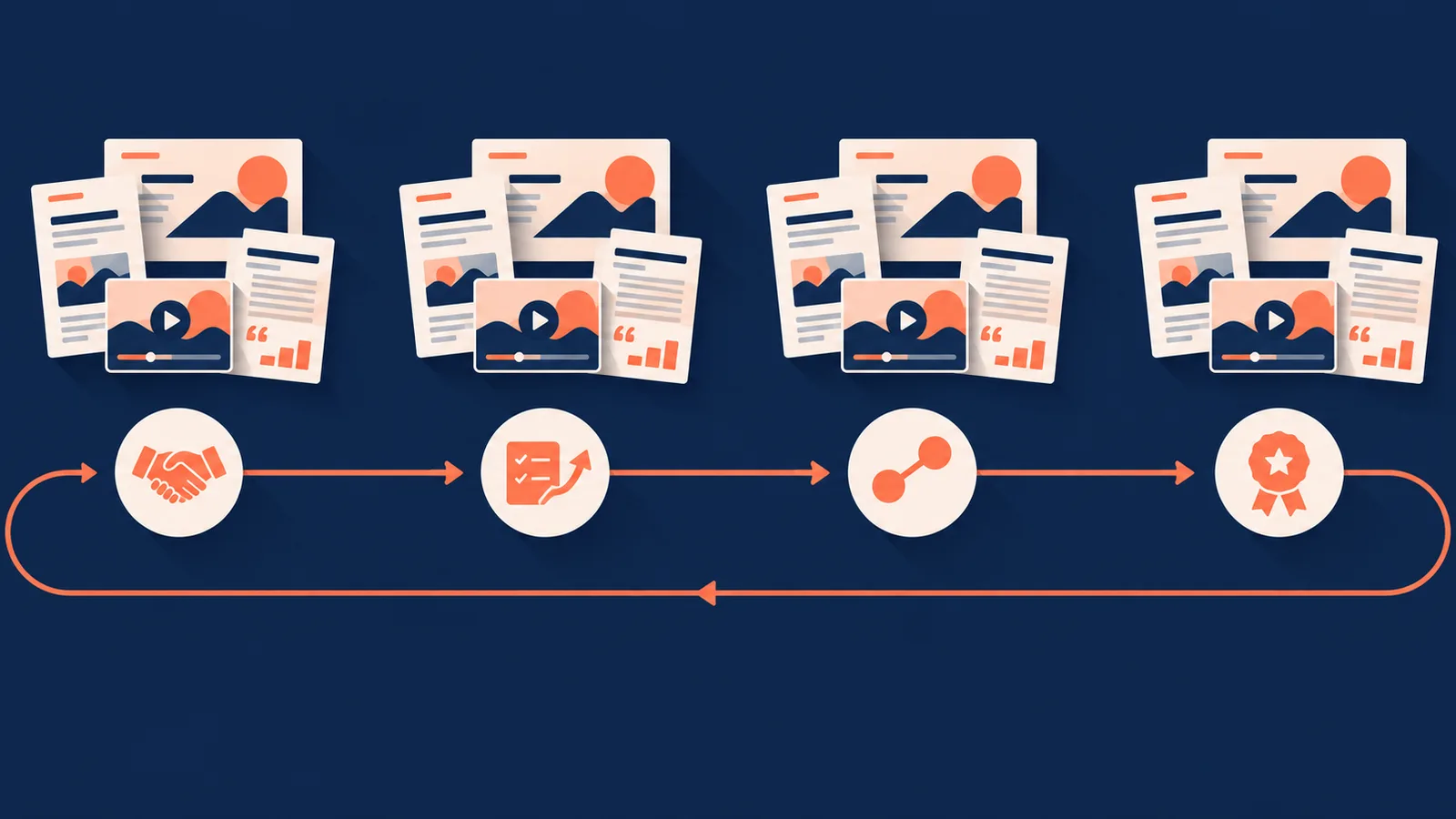
A dedicated team designs your collateral across the whole customer journey: sales, onboarding, referral, and advocacy. What it covers and how to choose one.

Covering a Designer’s Leave or Hiring Gap Without a 12-Month Contract
A maternity cover, a departure, or a launch needs capacity for a set period, not a permanent hire or a year-long contract. The options, and a faster way.