Types of Marketing Collateral, With Examples by Stage
The main types of marketing collateral, each with a concrete example and the job it does, organized by funnel stage, plus how to choose.
Marketing collateral spans a wide set of formats, and the clearest way to organize them is by the stage of the buyer journey each one serves. Awareness collateral introduces the problem, consideration collateral proves your fit, decision collateral removes risk, and retention collateral keeps customers and grows them. Below is the main set of types, each with a concrete example and the job it does, followed by how to choose which ones to produce. For the definition and the marketing-versus-sales distinction, see our guide to marketing collateral.
What counts as marketing collateral?
Marketing collateral is any branded, customer-facing asset a company uses to attract, educate, and convert buyers across the journey, from a blog post or infographic to a proposal or an onboarding kit. The useful question is not how many types exist, but which type answers the buyer's question at each stage. That is how the list below is built.
Awareness-stage collateral
At the top of the funnel the buyer is asking whether they even have a problem worth solving. The job is to attract attention, frame the problem, and build credibility, so these formats stay light and easy to scan.
| Type | Example | Its job |
|---|---|---|
| Blog post or article | A guide on a problem your buyer faces, tuned for search | Attract organic visitors and introduce the problem |
| Infographic | A single visual that explains a trend or a process | Make a complex idea scannable and shareable |
| Short social video | A 15 to 30 second clip that opens with the pain point | Stop the scroll and earn attention on social |
| Explainer or category one-pager | A one-page overview that defines the category and approach | Orient a new visitor quickly and capture the lead |
Consideration-stage collateral
In the middle of the funnel the buyer is asking what their options are and how your approach works. The job is to educate, build trust, and show why your way is different, so these formats go deeper and reward the reader's time.
| Type | Example | Its job |
|---|---|---|
| E-book or guide | A practical guide to solving the problem end to end | Educate in depth and earn a considered opt-in |
| Whitepaper | A researched point of view on the problem space | Build authority with a technical or senior buyer |
| Webinar or recorded session | A walkthrough of the approach with a live or recorded demo | Show the method and answer real questions |
| Case study | A story of how a similar company reached an outcome | Prove fit with evidence the buyer recognizes |
| Comparison sheet | A clear view of your approach against the alternatives | Help a shortlisting buyer see the difference |
Decision-stage collateral
At the bottom of the funnel the buyer is asking why you, and at what risk, often with a committee to convince. The job is to reduce risk, justify the investment, and make it easy to say yes, so these assets get specific and tailored to the account.
| Type | Example | Its job |
|---|---|---|
| Product demo | A tailored demo showing the product solving the buyer's own use case | Show the product working in the buyer's context |
| ROI or business case tool | An interactive sheet that estimates the value in the buyer's terms | Quantify the case for an internal approval |
| Sales proposal or pitch deck | A custom proposal with scope, timeline, outcomes, and terms for one account | Turn discovery into a clear, credible offer |
| Pricing or product sheet | A one-page summary of tiers, inclusions, and timelines | Make cost and packaging easy to compare and approve |
Retention-stage collateral
After the sale the customer is asking how to get value fast and whether to stay and expand. The job is to reinforce value, drive adoption, and open the door to more, so these assets are practical and ongoing.
| Type | Example | Its job |
|---|---|---|
| Onboarding kit | A welcome sequence with a checklist and short tutorials | Speed up time to first value and prevent early churn |
| Customer newsletter | A regular update with tips, stories, and product news | Stay present and useful between buying cycles |
| Review or QBR deck | A results deck for a quarterly business review | Show delivered value and set up renewal or expansion |
How do you choose which types to produce?
You do not need every type. A few filters make the call.
Start from the buyer's question at each stage, and build the asset that answers it, not the asset someone requested by name. Anchor each piece to a specific persona and the next action you want, since collateral built for a real buyer goal beats collateral built to tick a box. Match the format to the stage: light and scannable at the top, deeper in the middle, specific and tailored at the bottom, and do not send a long technical guide to someone who is only just discovering the problem. Plan distribution before you produce, because collateral that only sits in a folder is wasted, so decide upfront how each asset reaches the buyer. And review the library on a schedule, retiring or refreshing what is not earning its place.
How Room4 Teams produces your marketing collateral
Room4 Teams gives you a dedicated creative team that designs and maintains the full set: the awareness pieces, the consideration guides and case studies, the decision decks and one-pagers, and the retention assets, on brand and kept current. You own the strategy and the message; the team turns it into finished, consistent assets across every stage and format, from master templates that hold the whole library together. See what we produce.
You choose how it runs. The managed service takes the briefs and returns finished work, from one team member up, on one fixed monthly fee that covers unlimited tasks, unlimited revisions, and the full tech stack: all software, all AI tools, and all the stock videos and photos we use. The integrated option puts our people inside your tools, more integrated with your team, also from one team member up. On cost, a dedicated team runs around 45% less than the loaded cost of hiring the same role in-house (salary plus employer taxes). See pricing. The team starts within two business days and flexes with one month's notice. Read more on marketing collateral, sales collateral, and brand consistency at scale. Agencies can have the team work under their own brand.
What to do next
Map the collateral you have against the four stages and find the stage where buyers stall. Build the one asset that answers the question they are asking there. A small, current library outperforms a large, stale one.
Frequently asked questions
What are the main types of marketing collateral?
What is an example of marketing collateral?
How do you choose which collateral to produce?
How is marketing collateral different from sales collateral?
Do you need every type of marketing collateral?
More on Creative Production
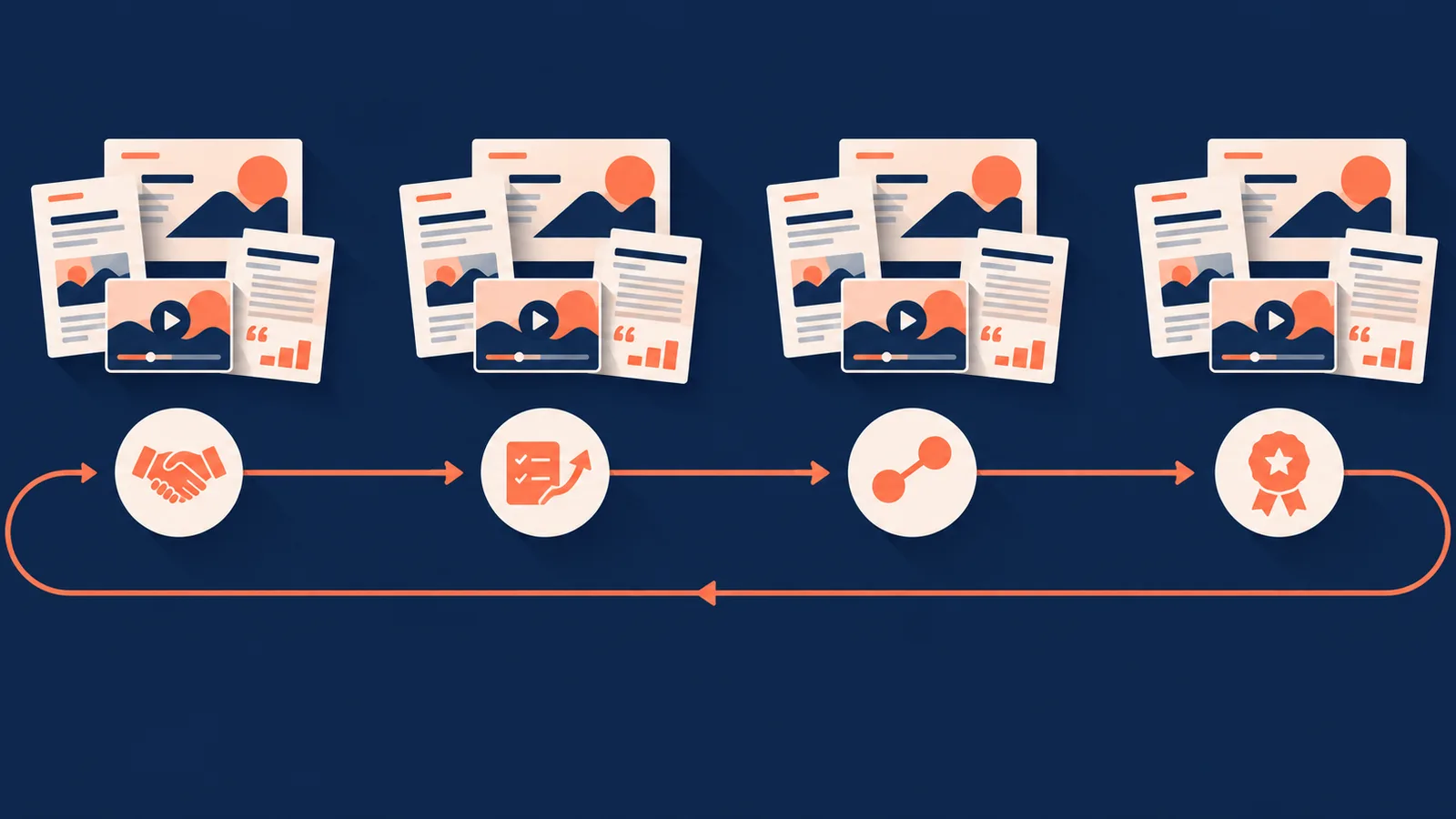
Marketing Collateral Design Services: The Whole Customer Journey
A dedicated team designs your collateral across the whole customer journey: sales, onboarding, referral, and advocacy. What it covers and how to choose one.

Covering a Designer’s Leave or Hiring Gap Without a 12-Month Contract
A maternity cover, a departure, or a launch needs capacity for a set period, not a permanent hire or a year-long contract. The options, and a faster way.

Creative overflow: handle the peaks without a freelancer scramble
Creative demand spikes then falls. Staff for the peak and you pay for idle time. Compare the overflow options and what gives capacity without a scramble.